

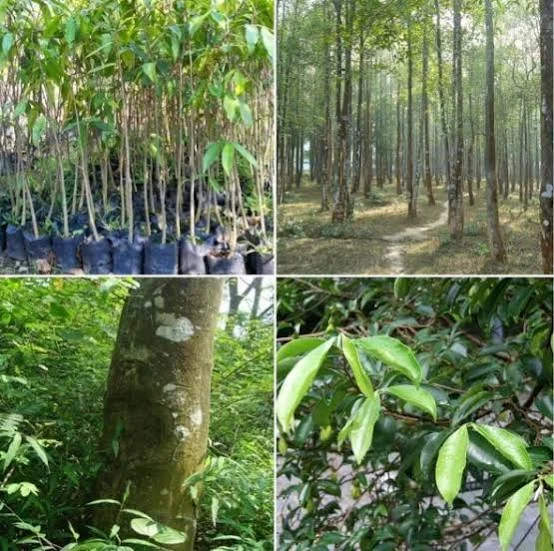
Agarwood cultivation focuses on growing trees from the Aquilaria genus to harvest a highly valuable, dark, and aromatic resinous heartwood. The tree does not naturally produce this resin; it only develops as a self-defense mechanism when the tree is wounded or infected by a specific mold. Because natural infection occurs in fewer than 10% of wild trees, commercial farming relies heavily on artificial inoculation to guarantee resin production.
☀️ Climatic & Soil Requirements
- Climate: It thrives in tropical and subtropical regions characterized by high humidity (70–85%) and robust annual rainfall ranging between 1,500 mm and 4,000 mm.
- Temperature: The ideal temperature ranges between 20°C and 35°C. It is sensitive to extreme temperature shifts. [1, 2, 3]
- Soil & Terrain: Highly prefers well-drained, acidic sandy loam or clay-sandy soils with a pH between 5.0 and 6.8. Plantations are ideally suited for sloping land or hilly terrain (elevations up to 1,000 meters) to prevent water stagnation.
🌱 Propagation & Planting
- Nursery Phase: Aquilaria produces recalcitrant seeds with a very short shelf life of 5 to 14 days. Seeds must be sown immediately upon maturation into nursery beds prepared with a mix of soil, cow dung, and coco-peat.
- Field Transplantation: Seedlings are ready to be transplanted once they reach a height of 60 to 90 cm. A standard spacing template is 1.5 to 2.5 meters apart.
- Intercropping: To optimize land usage and generate short-term revenue while the trees mature, farmers frequently practice intercropping with crops like tea, coffee, areca nut, and rubberwood.
💉 The Inoculation Process (Resin Induction)
Healthy Aquilaria wood is pale and lightweight. Once the trees reach 5 to 7 years of age and their trunks grow sufficiently thick, farmers induce the defense mechanism.
- Physical Wounding: Drill holes, drive iron nails, or create trunk cuts to compromise the inner bark.
- Biological/Chemical Inoculation: Injecting a specific fungal solution (e.g., Phialophora parasitica) into the wounds. The fungus spreads through the xylem, causing the tree to seal off the damage by secreting dark, heavy, and aromatic resin.
🪓 Harvesting & Yield
- Timeframe: Resin requires roughly 1 to 5 years post-infection to properly mature. The overall lifespan of a plantation from planting to final harvest spans 7 to 15 years.
- Method: Workers use chisels and specialized carving knives to meticulously shave away the healthy white wood, leaving only the dark, resin-soaked agarwood chips. The wood can also be ground up and steam-distilled to extract premium agarwood essential oil (Oud).
- Yield: A mature tree can yield approximately 30 to 40 kg of raw agarwood, producing roughly 4 kg of high-quality resin-segregated wood.
Project Details
Support this Project
Your small contribution can make a significant difference in the success of this initiative.
Donate Now