

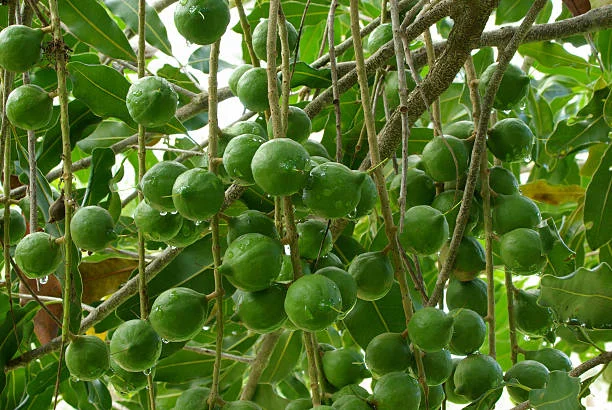
The Macadamia Cultivation Programme is a high-value commercial horticulture initiative focused on growing macadamia nut trees (Macadamia integrifolia). Often called the "Queen of Nuts," macadamias are among the most expensive tree nuts globally due to strong demand from the gourmet food, confectionery, and cosmetic industries.
For marginal and small farmers, macadamia programs represent a powerful long-term wealth-generation strategy. Because smallholder farmers have limited land holdings, these initiatives focus on optimizing land use, providing high-quality grafted saplings, and creating unified grower groups to secure high market prices.
Strategic Benefits for Marginal Farmers
- Maximum Returns on Minimal Footprint: Macadamia trees can be planted as boundary markers around existing plots, along fences, or in small home gardens. Once fully mature, a single healthy macadamia tree can yield 20–25 kg of nuts, translating to substantial recurring revenue from just a handful of trees.
- High Intercropping Compatibility: Macadamia trees require 4 to 5 years to start bearing fruit and reach peak production around Year 10. To protect marginal farmers from cash flow gaps, cultivation programs mandate intercropping. Farmers can grow short-term, low-height crops (like ginger, turmeric, pulses, or vegetables) between the tree rows to maintain steady seasonal income.
- Low Perishable Risk: Unlike fresh fruits or vegetables that rot quickly if not sold immediately, harvested macadamia nuts have a tough outer shell. Once dried, they can be stored securely for months, giving small farmers the flexibility to wait for optimal market prices rather than selling in a panic.
Suitability in Bihar, Jharkhand, and Uttar Pradesh
Macadamia nuts are native to the subtropical rainforests of Australia, meaning they thrive in deep, well-drained, fertile soils with moderate humidity and mild temperatures. Introducing them to Bihar, Jharkhand, and Uttar Pradesh requires careful geographical selection:
| StateSuitability LevelGeographical Advantages & Challenges | |||
| Jharkhand | High (Most Suitable) | Advantages: The undulating hilly terrains, sloped plateaus (Chota Nagpur region), and naturally well-drained, slightly acidic soils are ideal. Macadamias absolutely hate waterlogging, making Jharkhand’s slopes perfect. | Challenges: Young trees need protection from frost in high-altitude pockets during peak winter. |
| Bihar | Moderate (Region-Specific) | Advantages: The sub-Himalayan Terai belt and northeastern districts (like Kishanganj and Purnia) offer the high humidity and acidic, organic-rich soils that macadamias prefer. | Challenges: The flat plains of Central Bihar face severe waterlogging during monsoons (which causes root rot) and intense summer heatwaves (Loo). Mounds or raised bunds must be built for planting. |
| Uttar Pradesh | Moderate (Eastern & Northern Belts) | Advantages: The northern Terai region bordering Nepal and parts of Eastern UP (Purvanchal) have favorable soil depth and access to irrigation. | Challenges: The extreme dry heatwaves of Western UP and Bundelkhand can scorch young macadamia leaves. Mulching, windbreaks, and drip irrigation are mandatory to survive the summer. |
Critical Management Practices for the Region
For a macadamia program to succeed in these three states, farmers must adopt two strict protocols:
- Use Grafted Varieties Only: Farmers should never plant macadamia from seeds, as they take up to 8–10 years to fruit and yield unpredictable quality. Cultivation programs provide grafted saplings (using heat-tolerant scions), which dramatically reduces the fruiting wait time to 3–4 years.
- Wind and Shade Management: During the harsh North Indian summers, young saplings require temporary shade nets or fast-growing boundary trees (like sesbania or drumstick) to act as windbreaks against dry, hot winds.
Project Details
Support this Project
Your small contribution can make a significant difference in the success of this initiative.
Donate Now